
Stage 16 was not a particularly difficult stage. Unless you were team DSM, whose first two riders crashed on the first turn of the TT course, while showing up a few seconds late to the start… but that’s a WHOLE different issue.
The profile was didn’t really throw anything obstacles in the way. it was a mostly flat stage with a 2.5km kicker with a 9.4% average gradient, to the line. But the gradient softens at 19km.
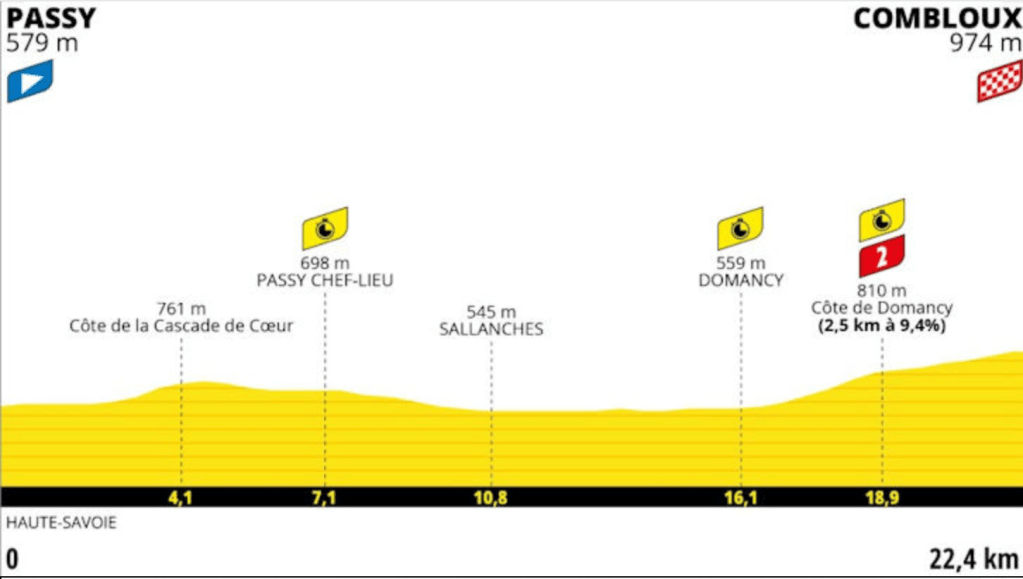
The question everybody had at the beginning of the race was, “Will that 2.5km kicker finish be enough, to necessitate a bike change at the bottom of Côte de Domancy? Well I am here to answer that question!
No… No I’m not, but I was able to make a fun graph and we can speculate! Below, is a graph that tracks the delta between amount of time that Jonas put on Tadej, compared to the prior checkpoint. So for instance he was 16″ ahead on the first checkpoint and 31″ ahead on the second, therefore 15″ delta.
The bike represents where UAE performed the bike changes, just in front of the foot of the climb.

This is missing a lot of information that is needed to get the full story, but I did see something interesting. The climb starts near to where the bike change is, and we can see that the time was fairly consistent. Making 15″ at each KM. Pogačar’s 18th kilometer was substantially faster compared to previous time checks. And then right at the 19th kilometer, Jonas hits the turbo and takes off gaining 10 seconds per km on Pogačar, right into the finish line.
At around 19km into the route, the course evens out. That’s where Jonas gained the majority of his time per km. I think Jumbo Visma may have found something out about marginal gains for world class cyclists. The average of Côte de Domancy is 9.4% but the first half is significantly higher gradient. That’s where Tadej was performing his best compared to Jonas, but the second the gradient lessened, Jonas was able to utilize the aerodynamic advantage of his TT position and TT bike, even on a climb.
World class cyclists are climbing at such a speed, that it’s time to rethink climbing vs aerobikes on climbs for these riders. They are climbing at such a speed, that the aerodynamics of the bike are having a more significant effect on the performance of the rider.
Similar to what we saw with Jumbo-Visma in the 2023 Giro, with Roglic putting time on an upkill time trial, using a 1X aero setup from SRAM, with a huge cassette in the back. This may be just another variable that Jumbo-Visma is considering when choosing equipment. They seem to be trying new things and with the success they’ve had in 2023, I don’t think we can discount these differences in tactics and tools.
To dampen the potential accuracy of my take, stage 17 was the following day. Which was the Queen’s stage of the tour, and that’s where Pogačar admitted defeat, “I’m Gone, I’m Dead.” I don’t think anybody could believe those words coming from Pogačar, as we’re all used to him coming through the finish as fresh as he went through the start. So there is something to say that maybe Tadej wasn’t 100 healthy those two days. Or the fatigue hit him harder than it had in previous grand tours.
I think that theory holds most water, because it took 3 days for Pogačar to see a top 10 finish in the tour again, when he won stage 20. As impressive as it is to say this, if Tadej doesn’t have a top 10 finish in the final stages of a grand tour, there is probably something else going on.
But I don’t think that discounts the point, that Jonas put more time into his opponent with a TT bike, on a more gradual climb. Where does the aero road bike fit in here? Is the lightweight climbing bike overused and less effective, at the speeds of these GT riders?

 Inthedraft.bike
Leave a comment