
“What are you doing? You’re 40 years old and furthest from a professional athlete, what are you doing?” This is what was going through my head as I was talking to Dave Liota at BeFitConsulting in Santa Cruz, California about a real VO2 test and how I could possibly get one. It was also what was going through my head as I made the 4 hour drive to Santa Cruz at 5am on a Sunday morning. Well I didn’t have an answer for myself until I had received the results.
But let’s start on what a VO2 Max test measures the maximum amount of oxygen someone can use during intense exercise for 1 minute or longer. VO2 Peak measures the peak of the Oxygen consumption, but for under 60 seconds. This is generally a good metric for cardiovascular health and changes with age, body composition, and exercise levels.
From a lay cyclist’s point of view, the setup was simple. I sit on my bike and give a good 15-20 minute warmup as Dave strapped a mask over my face and some sensors on my leg. What shocked me was the amount of different ways to perform a VO2 test and how to analyze the results. I never asked to dive into the differences, but we decided on a 3 minute ramp test. Which consists of different stages of power production that I will have to sustain for 3 minutes and then move up and max at around 300 Watts. The purpose of this was to analyze plateaus and not peaks. We want to see waht my body was doing through a sustained 250 watt period, not just a 1 minute effort.
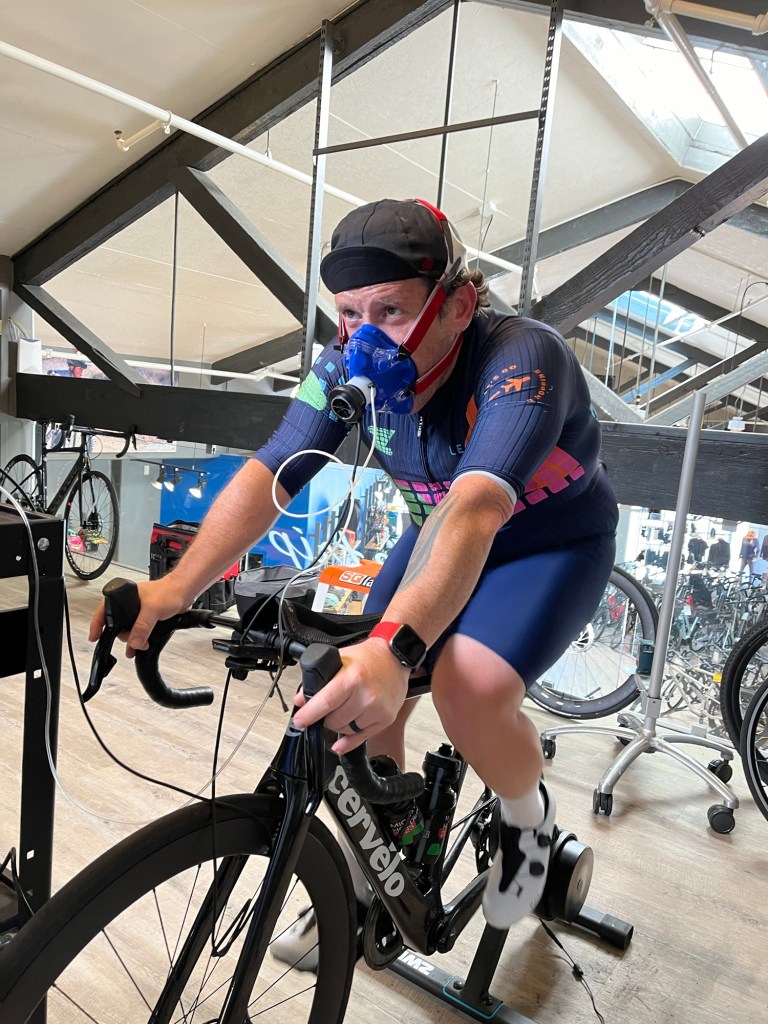
The beginning of the ramp test was really chill and quickly got hectic. the 3 minute intervals were like pins in my legs once we got beyond my FTP. Every few minutes Dave would hold up a chart on how much effort I was giving and instructed me to not speak and just focus on riding. Once I hit about 95% of my max and was about to wet my bibs, we called it and took a quick look at the results.

Something Cool
I’m not going to share my entire results and create a presentation because that would be too much work for this tiny little blog. But I wanted to share this. During the test, Dave had said, “Wow you have an enormous Zone 2.” At the time I had no idea what that meant. I understood the zones and how Zone 2 is a very popular training zone, but I didn’t know what that meant that I had a large Zone 2. To sum it up I can ride my bike for a very very very long time at a higher power than a rider who didn’t have a large Zone 2. This made sense as I love doing centuries, and can pretty much get one out with 3 water bottles and a couple of Cliff bars.
I asked, what type of rider that would make me… Would I be able to win in a break away with this type of physiological result? He laughed and said “No because you don’t have the kick to get away. You’d win in a 200 mile race because everybody would be dead by the time you’re getting warmed up.”
Not what I wanted to hear but luckily Dave said that with my large training base, I can build on top of it fairly quickly and easily with a tweak to my training.
So…What are the training tweaks?
Dave’s prescribed training is to cut my miles down. I had done over 300 miles the week before the Vo2 Test, and he wanted me to cut that down to 200 and add high intensity efforts more often. This will train my body to be more effective at higher efforts and allow me to grow a snappier kick. He also added gym work to my week. Work the legs with 12-15 rep efforts and core to allow me to maintain a lower riding position for longer.
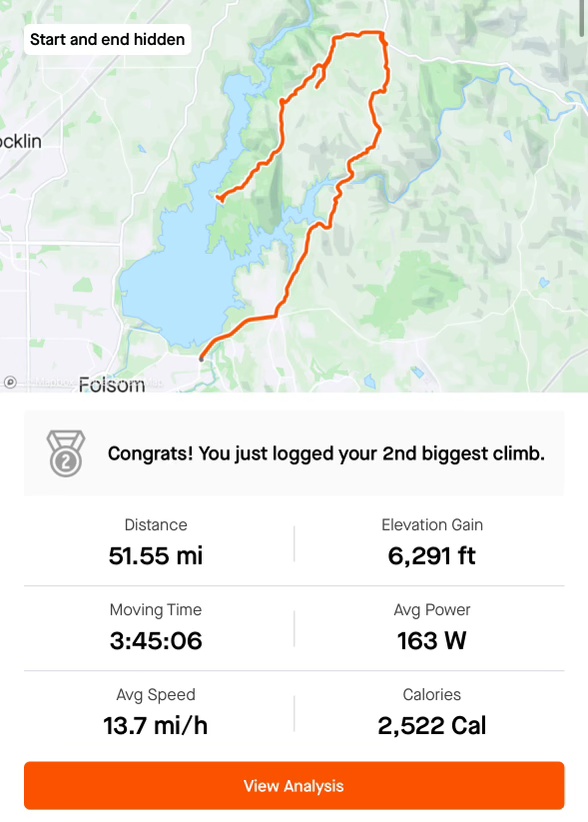
I added one day of 4×4 intervals and one day of climbing to my week in order to have a bit of variety to my riding. It also is making me drive to different locations to ride, as I live in the middle of a valley. So I drive up to the foothills and meet new people, see new things, and it’s been amazing to experience. Which ultimately is the whole point of cycling. But here’s an example of one of the climbing days that I recently did:
The most important learn was my nutritional needs. Scroll up and look at my zone 2 slide. EE (expended energy) is between 635-802 ph. I was undereating on my rides by an extreme amount. In Zone 2 I am spending around 700 calories an hour. I was expecting 200-400 to be perfectly honest with you all. I asked him about fuel sourcing for Zone 2. If I’m burning 700 calories of fat who cares? He said something very interesting that I’ve been repeating in my head before every ride, “The fat is burned in a carbohydrate flame.” You need the fire to burn the fat, and if you don’t have that you bonk. A friend summed it up really well too, “You need to eat 300 calories to burn 1700 calories.” It’s all basic science but when put into the perspective of my cycling performance it brings it down to earth and makes it a lot more relatable.
I’ve been eating a lot more on the bike and making sure I stop for those coffee stops. I have been maintaining / slightly losing weight and feel A LOT better on the bike after hour 2-4.
One of the benefits of taking so long to write this piece, is to be able to see my results in the few weeks that it’s taken me to put this together.
After my testing, I went into my Garmin cycling computer and updated all the zones to match my Vo2 Test results to allow myself the ability to see “real world” data on each ride. The zones never really matched and previously I had relied on Strava and Garmin to analyze my rides and set my goals. But now everything seems to link up. When my heart rate is in Zone 2, my power is typically in Zone 2 (as long as it’s a steady effort.) What’s really interesting is what my Garmin has been telling me as I train more and more to my new plan. My estimated FTP is rising and my results are correlating to my FTP increase. I am going faster, I am averaging more power, and harder rides are getting easier.
I’m not saying relying on your tech to estimate your fitness is inaccurate or not the thing to do because mine was within 15% of my actual results. For a computer that is analyzing my grocery store rides and my race rides as a whole… that’s pretty damn good.
On top of that, my max heart rate has increased by 6 BPM for the first time in a year. I was expecting that to increase with the added anabolic stress on my rides but I wasn’t expecting it that quickly. So many variables can play into that. And correlation does not necessarily mean causation, but anecdotal evidence is fun to look at sometimes.
Should you get a VO2 Test?
I can’t answer that… everybody is in a different place in their cycling journey and pedal for different reasons and goals. Sometimes it’s to have NO goals which is what some people need! But I want to ride faster than I ride now. And even with my very limited understanding of the physiological effects on the body during a hard cycling effort, I understand MY physiology a lot more and to a deeper level. I now know where in my Zone 2 I want to hang on different efforts and rides. I know where to chill on hard climbs and where I can go on intense climbs and how I can recover faster for the next one. Its made my rides more enjoyable now that I’m eating enough, and I know how much water and salts I need per hour, so I know how I need to hydrate.
So it was absolutely worth it to me because every single ride I have now, is much more enjoyable and I can do more of it!

 Inthedraft.bike
Leave a comment